The Certified Alternative
to A Slate & Slate Mate*
* No minimum 50mm rafter.No 19mm rafter/slate gap restriction.
IPX8 watertight. A4-80 marine-grade steel. Zero tiles removed. Full technical comparison below.
The Context
A Slate & Slate Mate: Why UK Installers Are Looking for an Alternative
Roof plate style slate mounting systems — the A Slate, Slate Mate, Solar Limpet — have been a default choice for many UK solar installers for years. As MCS standards tighten, warranty expectations lengthen, fire regulations change and coastal corrosion risk is scrutinised more closely, more professionals are re-evaluating their product selections.
The SolVe Mount works differently: a 28mm diamond core through the slate, a bolt direct into the rafter, and a VMQ silicone seal that expands to fill the core hole. No sealant. No flashing. No compression on the covering. No batten depth or rafter gap restrictions.
This page gives you the full technical picture, drawn directly from manufacturer installation manuals and certified test data.
Standard UK roofing battens measure 25mm, 38mm, or 50mm. Add even a thin natural slate (6–8mm) and the rafter-to-covering surface gap typically sits between 31mm and 58mm — structurally normal, but well outside the A Slate's permitted 19mm window. The SolVe Mount has no such restriction: the seal travels up or down the bolt thread to match any required height, on any batten size, on any slate thickness. See the Petersfield Community Hospital installation for a real-world example across multiple rafter widths and slate depths.
See the full mechanism explainedTechnical Comparison
A Slate · Slate Mate
vs SolVe Mount
Data sourced from publicly available manufacturer installation manuals and BBA Certificate 7460 / MCS 012 3.0 test report. Accurate as of August 2026.
| Category | CompetitorA Slate / Slate Mate | SolVe InnovationsSolVe Mount |
|---|---|---|
| WATERTIGHT RATING | Unrated. Only effective on flat coverings — not over overlapping or thick slates. | IPX8 certified — 8.2× the pressure of a 1-in-50-year UK storm (100 mph rain). |
| SEAL MECHANISM | Sealant-filled rings + compression on the covering surface. | VMQ silicone expands radially inside the 28mm core hole. |
| ROOF WORK | Drills through the covering in two locations per fixing point. | 28mm diamond core only. Zero tiles removed. Zero covering drilling. |
| LOAD PATH | Covering bears load if rafter-to-slate gap is not EXACTLY 19mm. See Critical Finding ↓ | All mechanical load channels direct into the rafter. Zero load on the covering. |
| RAFTER WIDTH | 50mm MINIMUM rafter width required. | 20mm MINIMUM rafter width (pre-drill). No rafter width restriction in practice. |
| STEEL GRADE | A2 stainless steel. | A4-80 marine-grade throughout, 33% stronger than A2-70 by yield. |
| CORROSION | A2 corrodes over time. Accelerated risk within 25 km of the coastline. | A4-80 marine-grade — no coastal restriction. |
| FIRE / MCS | Fire rating preserved. | Fire rating preserved · MCS 012 3.0 compliant · BBA Certificate 7460. |
| WARRANTY | 5–12 years depending on product variant. | 20-year leak-free guarantee. |
| Verdict | 2 critical limitations | Certified. Low Risk. |
Competitor data sourced from publicly available manufacturer installation manuals and product specifications. SolVe Mount data from BBA Certificate 7460 and MCS 012 3.0 test report. All data accurate as of August 2026.
From the manufacturer's own published manual — A Slate v2.7, page 3
Two Critical Limitations — A Slate
"Do not install the A-SLATE if the measurement between the rafter and the slate roof surface is greater or less than 19mm. If the measurement is not precisely 19mm, then the A-SLATE is not suitable for the installation as it may transfer load that could damage the slate roof covering or affect the weather sealing ability of the neoprene gasket."
Standard UK roof battens are 25mm thick. That puts the rafter-to-slate gap beyond 19mm before slate thickness is counted. Per the manufacturer's own specification, the A Slate must not be installed on the majority of standard UK slate roofs.
"50mm minimum rafter or batten thickness."
Source: A-Slate / P-Slate Installation, Use and Maintenance Instructions v2.7 — Page 3, System LimitationsThe vast majority of UK rafters are 47mm or 38mm wide. Both fall below the A Slate's 50mm minimum. That alone rules out the A Slate on most UK roofs.
Source document — A Slate Technical Specification, page 3
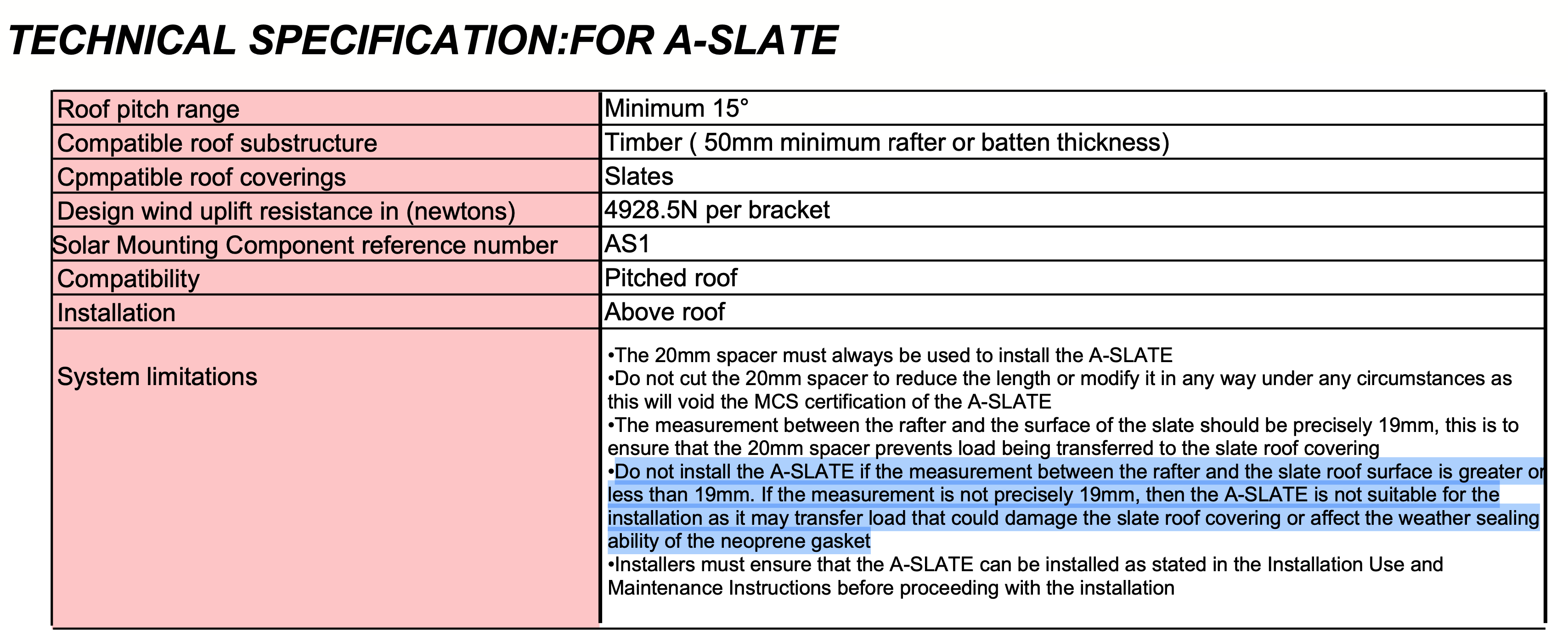
A Slate / P-Slate Installation Manual v2.7 — Page 3, System Limitations table (highlighted rows)
Conclusion from A Slate's own specification
The 19mm gap requirement and 50mm minimum rafter thickness requirement, read together, mean the A Slate is unsuitable for the vast majority of UK slate roof constructions, per the manufacturer's own published installation manual. This is not a competitor's claim; it is a direct reading of the A Slate specification document.
Note: SolVe Innovations makes no claims about the certification status of any competing product. All quotations above are verbatim from the A Slate / P-Slate Installation, Use and Maintenance Instructions, version 2.7, page 3, published by the manufacturer and publicly available via Midsummer Wholesale.
The SolVe Approach
A different system
Roof plate style systems sit on top of the slate and rely on compression seals. If the rafter-to-slate gap isn't exactly 19mm, wind and snow load goes through the covering. SolVe works through the slate, transferring all mechanical load to the rafter and sealing the core hole.
Zero load on the covering
A 28mm diamond core creates the working hole. The slate stays in place. All mechanical force routes directly into the rafter, regardless of batten depth or slate thickness.
IPX8 Rated
The VMQ silicone seal expands radially against the core hole walls. No flashing, no sealant, no compression on the covering.
A4-80 — no coastal restriction
Marine grade. 80% of UK landmass is located within 25km of a coast.
MCS 012 3.0 · BBA 7460
MCS 012 3.0 compliant. BBA Certificate 7460. No audit & removal risk.
Three steps. Any competent trade.
How it installs
Core
28mm diamond core through the slate. No tile removed. Rafter located with the SolVe Rafter Finder app before coring.
Fix
Pre-drill the rafter through the core hole using the included drill guide. Assemble and drive the SolVe Mount bolt into the rafter.
Seal
Tighten one nut. The VMQ silicone sleeve expands against the core hole walls. IPX8 watertight.
Material Pedigree
The Seal Trusted Where Failure Isn't an Option
When failure means a downed aircraft or a breached reactor, engineers choose VMQ silicone. SolVe Mount uses the same seal material family — proven across six decades in environments that make a British roof look trivial.
Space
International Space Station
Docking port seals and habitat pressure boundaries. A single failure breaches a pressurised environment in orbit.
Aviation
Boeing · Airbus · Rolls Royce
Pressure cabin door seals, jet engine assemblies, and aircraft fuel systems. Maintains integrity through thousands of flight cycles from −60 °C to over 200 °C.
Nuclear
Power Generation
Containment gaskets in nuclear stations where chemical resistance and zero compression-creep are non-negotiable.
Defence
BAE Systems
Submarine pressure seals, naval vessel systems, and defence electronics requiring long-term environmental resistance.
A British roof is the easiest environment it will ever face.
Common Questions
Frequently Asked Questions
Do you drill through slate?
No. Diamond coring is used for low risk access to the rafters. A 28mm diamond core bit cuts through the slate cleanly — the surrounding covering is left fully intact.
Is the bolt too big for the rafter? Will the bolt split the rafter?
No. The rafter is pre-drilled with a 7mm wood auger before the M10 bolt is fixed. This method has been tested to Eurocode 5 and poses no risk of splitting under normal installation conditions.
What is the A Slate 19mm installation limitation?
According to the A Slate Installation, Use and Maintenance Instructions v2.7, page 3 (System Limitations), installers should not install the A-SLATE if the measurement between the rafter and the slate roof surface is greater or less than 19mm. Standard UK roof battens are 25mm or greater — meaning the gap typically exceeds this requirement before slate thickness is even added.
Is the SolVe Mount certified for slate roofs?
Yes. The SolVe Mount holds MCS 012 3.0 certification and BBA Certificate 7460 for slate and a wide range of other roof coverings, including natural slate, composite slate, heavy slate, and Cambrian interlocking slate.
Does fitting the SolVe Mount affect the roof's fire rating?
No. The semi-organic VMQ Silicone weighs <40g. Under Buildings Regulations Approved Document B, only organic/semi-organic compounds weighing more than 200g/m² are not exempt — such as in-roof solar systems (GSE) and potentially plastic flashing.
What guarantee does it come with?
The SolVe Mount carries a 20-year leak-free guarantee. The seal would have to lose 98% of its sealing pressure despite only being compressed by 25–30% to be at risk of leaking.
How long does an installation take?
A trained installer typically fits a SolVe Mount in under 60 seconds per unit. A team of 2 can install 4 SolVe Mounts in two minutes.
Does it work on all slate thicknesses and batten sizes?
Yes. The SolVe Mount has no restriction on the distance between the rafter and the slate surface. Simply twist the seal to travel up/down the bolt thread to match the required height.
Can the SolVe Mount be used on listed buildings?
The SolVe Mount is regularly specified on listed and conservation area properties due to its lower risk to the roof covering — see our listed buildings guide for more detail.
Keep Reading
Related Articles
Solar Panels on a Slate Roof
Everything you need to know about mounting solar on natural and composite slate.
Built to Last: IPX8, A4-80 & Fire Safety
The engineering behind the SolVe Mount seal, bolt, and fire rating.
Which Solar Panel Mounting Is Best?
A full comparison of hook, flashing, and core-hole mounting systems.
Cambrian Interlocking Slate
SolVe Mount compatibility, coverage, and installation notes for Cambrian slate.
Heavy Natural Slate
Thick slate roofs, large batten gaps — and why gap restrictions matter more here.
Composite & Fibre Cement Slate
Composite and fibre cement slate profiles — coverage, drill-through risk, and alternatives.