Now on the App Store — Free to Download
Find EveryRafterUsing Just Your Phone.
Rafter Finder locates every rafter through the tiles — no guesswork, no removal, no delays.
Download Free — Now on the App Store

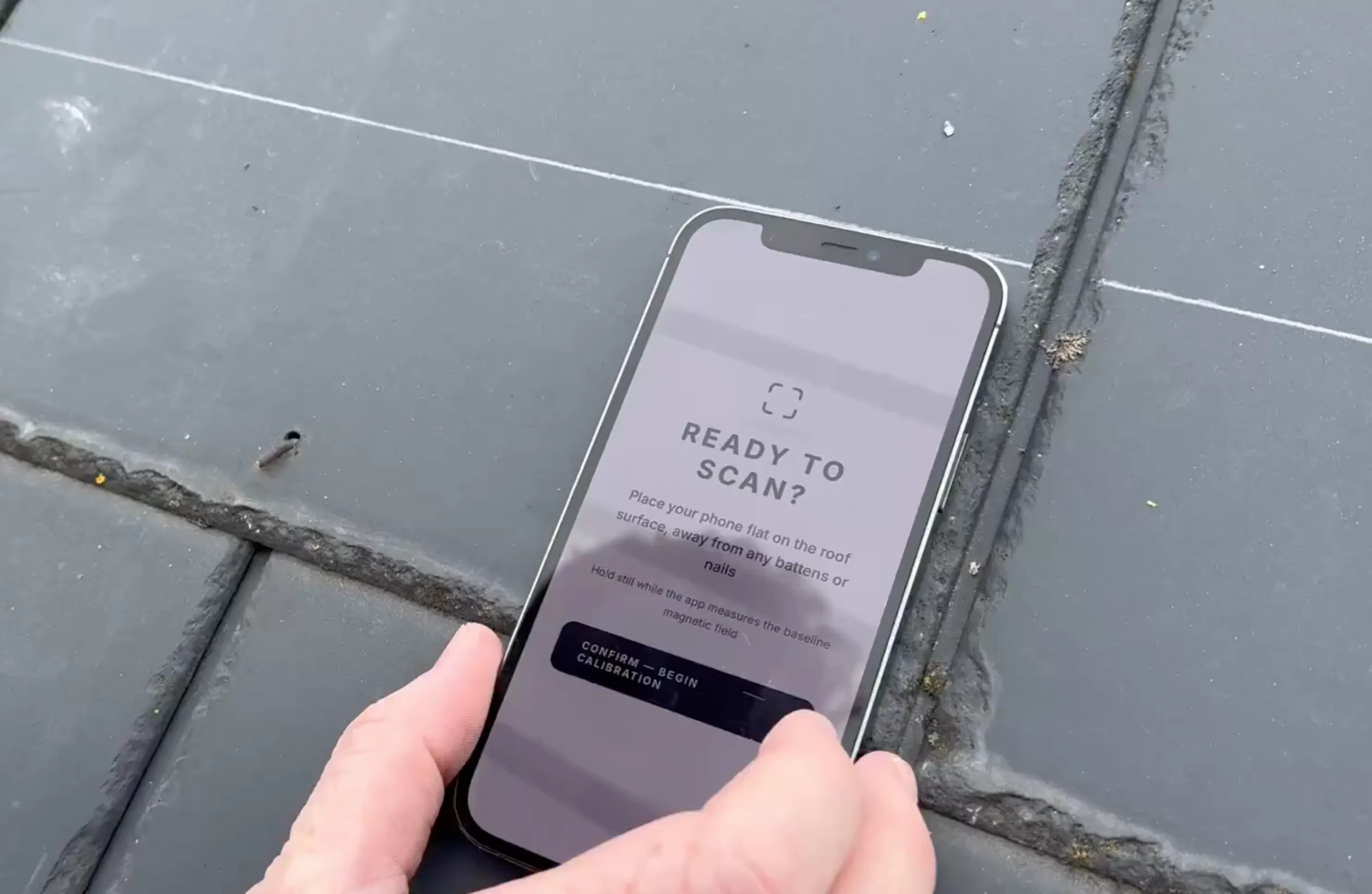
Real Slate Roof Installation, Ipswich
In Action
See Rafter Finder in Action
Watch Rafter Finder locate the rafter through the tiles — then the SolVe Mount goes in. No guesswork, no removal.
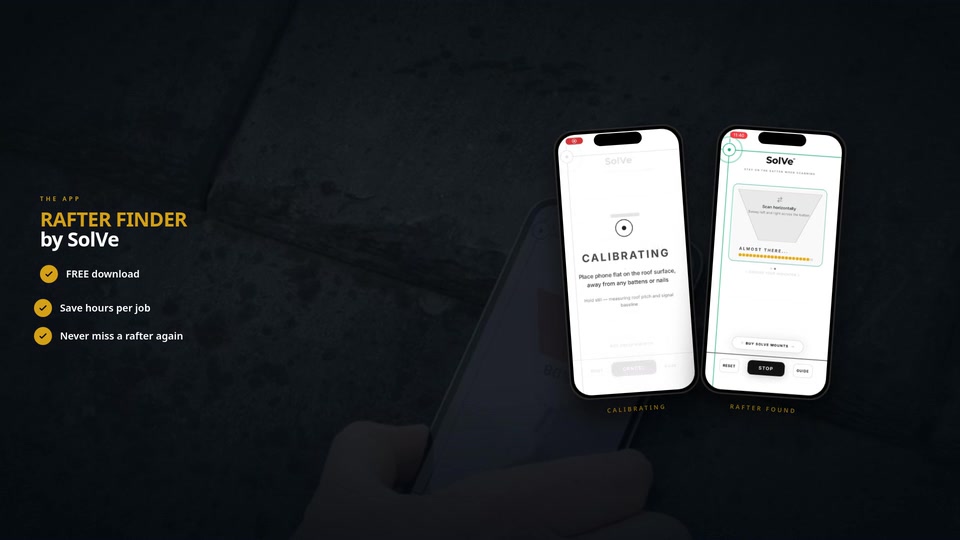
Built for Installers
Every second on a roof matters. Rafter Finder eliminates the most frustrating part of a solar install.
Never Miss a Rafter
Locate every rafter through the roof covering without removing a single tile. Accurate every time.
Save Hours Per Job
Stop guessing, stop probing, stop wasting fixings. Rafter Finder cuts rafter location time to near zero.
Easy to Use
If you can point a phone at a roof tile, you can use Rafter Finder. No training required — just open and scan.
Now on the App Store
Free to download on iPhone. Available now on the App Store — Android coming soon.
Real World
Watch It Work
Rafter Finder in action on a real roof. Scan, locate, fix — in seconds.

How It Works
Clear, Instant Feedback
The app tells you exactly what to do at every step. Ready. Scan. Confirmed.

1. Ready & Calibration
Place the phone flat on the tile. The app confirms it's ready and calibrated.

2. Scan & Confirmed
Slide across the tile. When the indicator lights, you have found a rafter nail — millimetre accurate. Two or three readings in a vertical line mark the rafter.
The Problem With Stud Finders
Why Stud Finders Cannot Find Roof Rafters
Two physical barriers make it impossible. The first is the density of the slate or tile itself — the material absorbs or reflects the sensor signal before it can reach the rafter. The second, and more significant, is the air gap between the underside of the covering and the rafter beneath. Even a shallow gap is enough to break the detection logic entirely, because the sensor reads the air rather than the timber.
The counter-intuitive problem is that the more sophisticated the detector, the worse the result. Standard stud finders use capacitance or simple density sensing. More expensive models — including the Bosch D-TEC 200 and the Makita DWD — use a form of ground-penetrating radar, which is more powerful but generates more reflections off the air gap, producing noisier and less reliable readings. Investing in a premium device does not solve the problem; it amplifies it.
You do not need a stud finder to find the rafters on a slate roof. You need the Rafter Finder by SolVe app, and the phone you already have.
Coverage Guide
Will It Work on My Roof?
The critical factor is the distance between the roof covering and the rafter nail. Thin coverings work straight away — for thicker ones, use magnets.
Works Directly
Thin Roof Coverings
The sensor detects the rafter nail directly through the covering. No extra equipment needed — just scan.
- Natural slate
- Cambrian slate
- Thin single-lap tiles
- Most fibre-cement slates
Use Magnets
Thick Roof Coverings
Thicker coverings place the rafter nail too far from the sensor for reliable detection. Place 3 neodymium magnets equally spaced along each rafter and the app detects them with pinpoint accuracy. Space them out — don't stack them together.
- →Heavy natural slate
- →Plain clay or concrete tiles
- →Interlocking concrete tiles
- →Double-lap coverings
On the Roof
Designed for the Real World
Rafter Finder works on an actual roof, in daylight. It was built by installers, tested on live jobs, and refined until it worked every time.
- Works through all roof coverings. Limited by sensing distance to the rafter. For thicker coverings consult the in app guide.
- Readable in direct sunlight
- No internet connection required on the roof
- Confidence indicator - no more guessing

Now on the App Store
Download It Now
Rafter Finder is available now, free to download on the App Store. Android coming soon.
Common Questions
Frequently Asked Questions
How do you find rafters on a slate roof?
The traditional methods — stud finders, tapping, and probing — are unreliable on slate because the air gap between the slate and the rafter prevents accurate detection. Rafter Finder by SolVe uses the sensors already inside your iPhone to locate every rafter through the tiles accurately, without removing a single slate.
Do stud finders work on a roof?
Standard and expensive stud finders do not work reliably on a roof. The air gap between the roof covering and the rafter — even just the batten depth — is enough to cause false or missed readings. Devices using ground-penetrating radar, including professional-grade units costing thousands of pounds, suffer from the same problem. The Rafter Finder app was built specifically because no off-the-shelf stud finder could solve this.
How do you find rafters on Cambrian slate?
Cambrian slate is a thin interlocking covering, which means Rafter Finder works directly — no magnets required. Point your iPhone at the roof surface, slide across, and the indicator shows where each rafter nail sits, accurate to the millimetre. Two or three readings in a vertical line mark the rafter.
Can you find roof rafters without going in the loft?
Yes. Rafter Finder locates every rafter from outside, scanning through the roof covering. There is no need to go into the loft, remove tiles, or probe by hand.
For thicker coverings such as plain tile, stone and some concrete tiles, place neodymium magnets along the rafter for easy detection.
Why can't stud finders locate the rafters below a slate roof?
Two physical barriers make it impossible. The first is the density of the slate or tile itself — the material absorbs or reflects the sensor signal before it can reach the rafter. The second, and more significant, is the air gap between the underside of the covering and the rafter beneath. Even a shallow gap is enough to break the detection logic entirely, because the sensor reads the air rather than the timber.
The counter-intuitive problem is that the more sophisticated the detector, the worse the result. Standard stud finders use capacitance or simple density sensing. More expensive models — including the Bosch D-TEC 200 and the Makita DWD — use a form of ground-penetrating radar, which is more powerful but generates more reflections off the air gap, producing noisier and less reliable readings. Investing in a premium device does not solve the problem; it amplifies it.