How Long Does a SolVe Mount Seal Last? VMQ Silicone vs Flashing
The same class of seal material keeping astronauts alive on the International Space Station, maintaining cabin pressure in commercial aircraft at 35,000 ft, and encasing cardiac pacemakers inside the human body — is the material sealing your roof penetration. The question is not whether it will last. The question is whether anything else can match it.
Every factual claim in this article is linked to a primary source — a peer-reviewed paper, a NASA Technical Report, a certified manufacturer, or a published industry standard. No extrapolation, no marketing copy.
Key Takeaways
VMQ silicone (ISO 1629) is the reference seal material for NASA's ISS docking mechanisms, commercial aircraft doors, nuclear containment vessels, and FDA-approved medical implants
NASA Technical Reports document silicone seal performance under vacuum, −75 °C to +125 °C thermal cycling, atomic oxygen, and particle radiation — conditions far more demanding than any UK roof
Aircraft door seals use Boeing-specified BMS 1-57 silicone rubber, surviving 8–9 psi pressure differentials on every flight cycle for a 20–25 year aircraft life
Service life: projected beyond 100 years in a mild roof environment, based on accelerated thermal ageing studies and the inherent stability of the Si–O backbone
vs ABS solar flashing: carbon-stabilised ABS flashing is held by a hook tied to the slate and sometimes stuffed with neoprene — a 10-year warranted product exposed directly to UV, with no formed compression seal at the tile interface
Verdict: the SolVe Mount VMQ seal is a superior sealing solution — expands within the core hole like a rivet, no downward pressure on the roof covering, no hooks, no stuffing, no brittleness in frost, no UV degradation
Table of Contents
1. What is VMQ Silicone?
VMQ is the ISO 1629 designation for Vinyl Methyl Silicone Rubber — the most widely used class of silicone elastomer in industrial, aerospace, and medical applications. The "V" denotes vinyl groups added to a polydimethylsiloxane (PDMS) backbone; the "M" denotes methyl side-chains.
The defining property of VMQ is its backbone: alternating silicon and oxygen atoms (Si–O–Si), known as a siloxane chain. This is fundamentally different from the carbon–carbon (C–C) backbone of organic elastomers such as EPDM, neoprene, or natural rubber. The Si–O bond is more thermally stable, more resistant to UV photodegradation, and more chemically inert than a C–C bond.
VMQ Silicone — Key Properties
ISO designationVMQ (Vinyl Methyl Silicone), per ISO 1629
Continuous service range−60 °C to +200 °C
Short-term peakUp to +250 °C
UV resistanceExcellent — no photooxidative degradation
Ozone resistanceExcellent — Si–O backbone is ozone-inert
Compression setGood — retains sealing force under long-term load
Chemical inertnessResistant to water, steam, oxygen, many solvents
BiocompatibilityFDA-approved grades for permanent implantation
Sources: ISO 1629; Power Rubber VMQ reference; Rubber & Seal VMQ material guide
VMQ silicone has been in commercial production since the 1940s. NASA has used it in aerospace applications since the Apollo programme. The material's longevity is not theoretical — it is documented across six decades of real-world deployment in the most demanding environments engineering has to offer.
2. Space: ISS Docking Seals
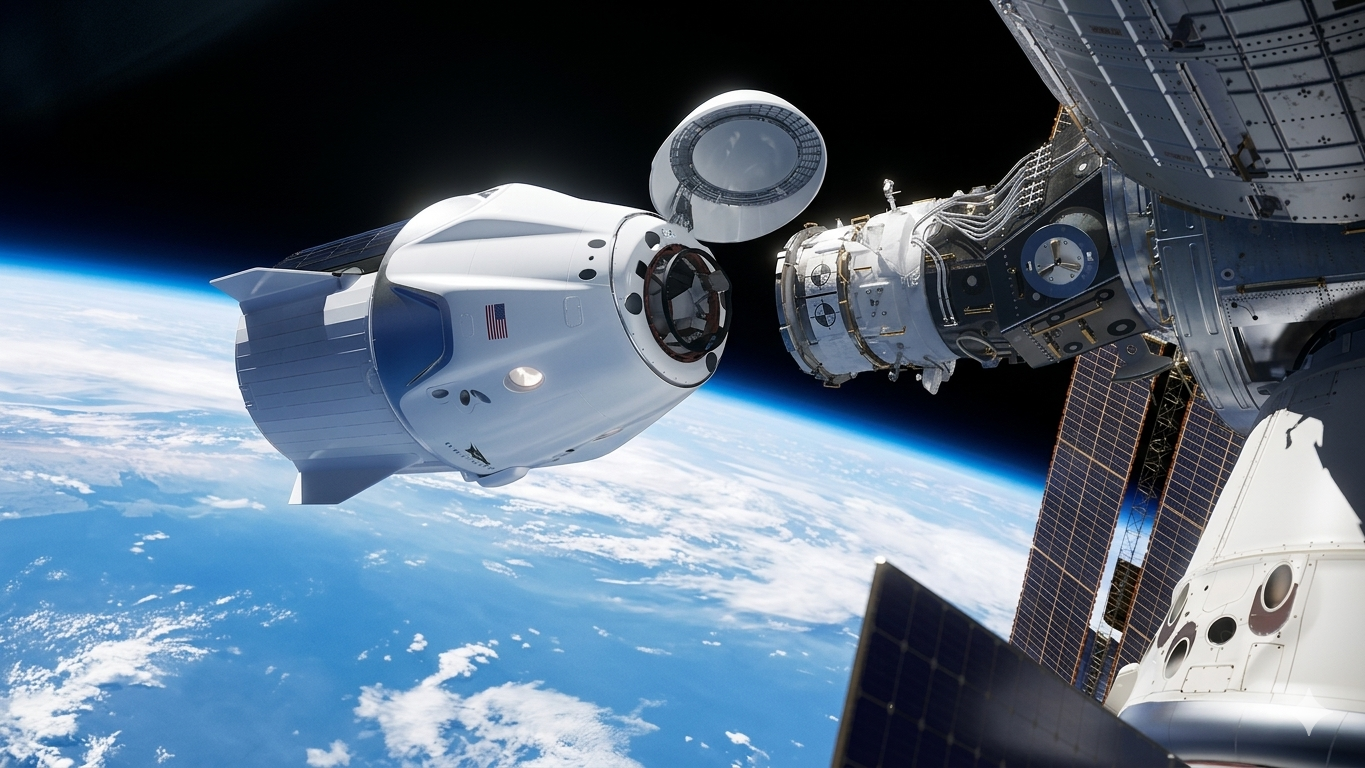
Every crewed docking to the ISS relies on a silicone elastomer seal. Image: AI-generated illustration.
The International Space Station has been continuously crewed since November 2000. It represents approximately $100 billion of engineering investment from fifteen nations. Every time a Crew Dragon, Soyuz, or visiting cargo vehicle docks with it, the only physical barrier between the crew and the vacuum of space — at the moment of docking ring contact — is a silicone elastomer seal.
NASA Glenn Research Center published two peer-reviewed Technical Reports documenting the specific performance of silicone seal materials in low Earth orbit:
NASA Technical Reports — Silicone Docking Seals
NASA/TM–2010–216332
Space Environment Effects on Silicone Seal Materials — Henry C. de Groh III et al., NASA Glenn Research Center (2010).
Exposed silicone seal specimens to simulated low Earth orbit: vacuum, atomic oxygen flux, ultraviolet radiation, and thermal cycling from −75 °C to +125 °C. Evaluated mass loss, hardness change, tensile strength, and compression set before and after exposure. The study was conducted to qualify materials for the NASA Docking System (NDS).
Effects of Low Earth Orbit on Docking Seal Materials — Emily C. Imka, Olivia C. Asmar, Henry C. de Groh III, Bruce A. Banks, NASA Glenn Research Center (2014).
A follow-on study examining mass loss and material property changes in docking seal elastomers after simulated LEO exposure, including atomic oxygen impingement at orbital velocity.
The conditions these seals endure on every mission include:
Thermal cycling from −75 °C to +125 °C — a 200 °C swing — on every orbit (approximately 16 orbits per day)
High vacuum (~10⁻⁵ Pa), which causes outgassing and plasticiser loss in inferior materials
Atomic oxygen bombardment at orbital velocity — highly reactive, capable of eroding organic polymers
UV and particle radiation at levels orders of magnitude above ground-level exposure
NASA selected silicone elastomers — and specifically evaluated their performance under these conditions — because no other elastomer class survives the combination of extreme thermal cycling, vacuum, and atomic oxygen that characterises low Earth orbit.
NASA — Sealed with Care
"Sealed with Care" — a Q&A published on nasa.gov — describes the engineering rigour applied to ISS docking seals, including material selection, testing, and the consequences of a seal failure.
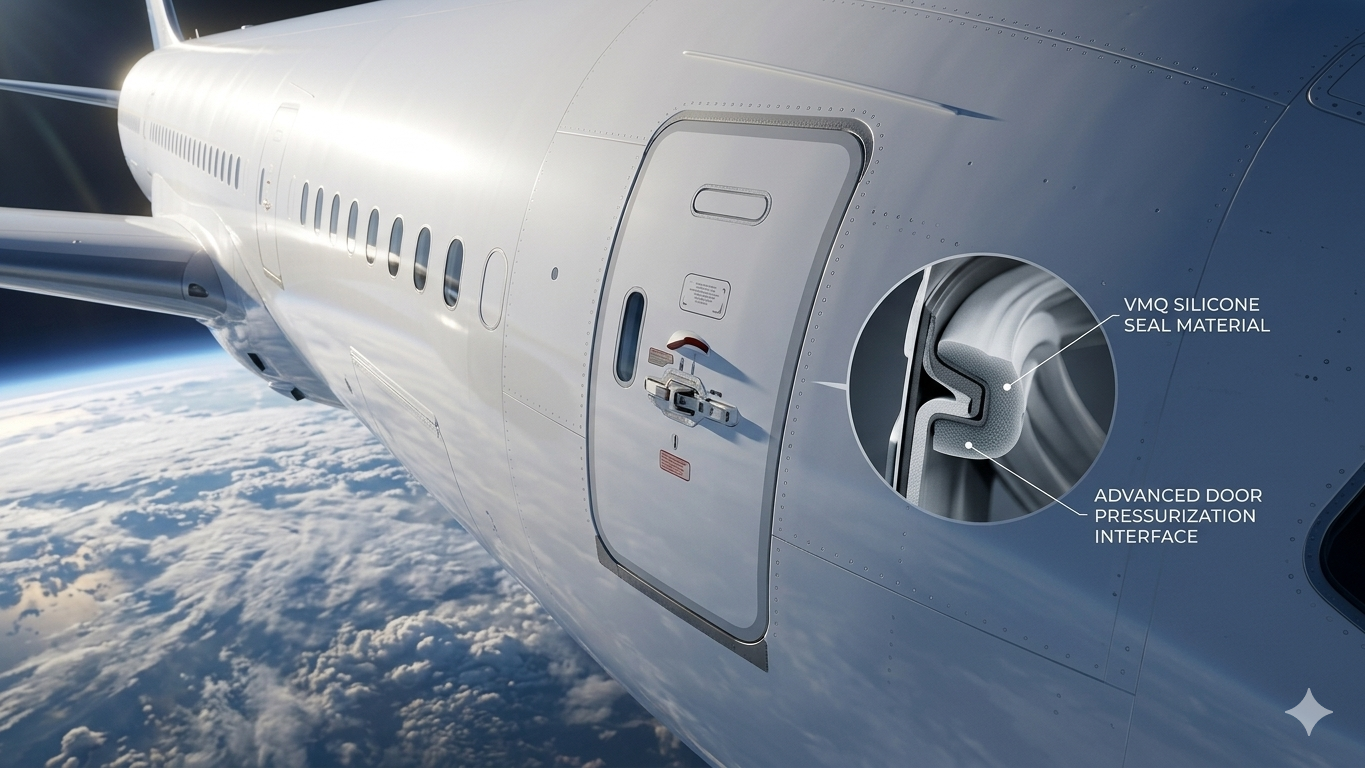
Aircraft door seals use Boeing-specified BMS 1-57 silicone rubber. The seal maintains cabin pressure at 35,000 ft on every flight. Image: AI-generated illustration.
At cruise altitude — typically 35,000 to 40,000 ft (10,700–12,200 m) — the atmospheric pressure outside a commercial aircraft is approximately 20–26 kPa. The cabin is pressurised to an equivalent of approximately 6,000–8,000 ft altitude, creating a differential pressure of roughly 8–9 psi (55–62 kPa) across the fuselage skin and door seals on every single flight.
Boeing's material specification BMS 1-57 defines silicone rubber as the required material for flight-critical door sealing applications. Cascade Gasket & Manufacturing — a certified aerospace manufacturer — describes manufacturing BMS 1-57 silicone exit door seals:
"Cascade Gasket assisted in the design and then manufactured this flight critical exit door seal for a commercial aircraft. The seal effectively blocks both air and water from the aircraft's interior, in flight and while grounded, and is composed of three materials: BMS 1-57 silicone rubber, D2000 inter-weave fabric, and inconel metal inserts..."
A typical commercial aircraft completes 20,000 to 30,000 pressurisation cycles across a service life of 20–25 years. On every cycle, the door seal is compressed to maintain cabin pressure, then relaxes on the ground. The temperature the seal experiences ranges from approximately −60 °C at altitude to well above +40 °C on a hot runway — a thermal range of 100 °C, applied thousands of times.
VMQ silicone is specified because it resists compression set — the tendency of an elastomer to take a permanent deformation under sustained load. A seal that compression-sets no longer returns to its original shape when pressure is released, and the seal fails. VMQ silicone maintains its recovery across the full temperature range and across thousands of cycles.
4. Medical: Life-Critical Implants
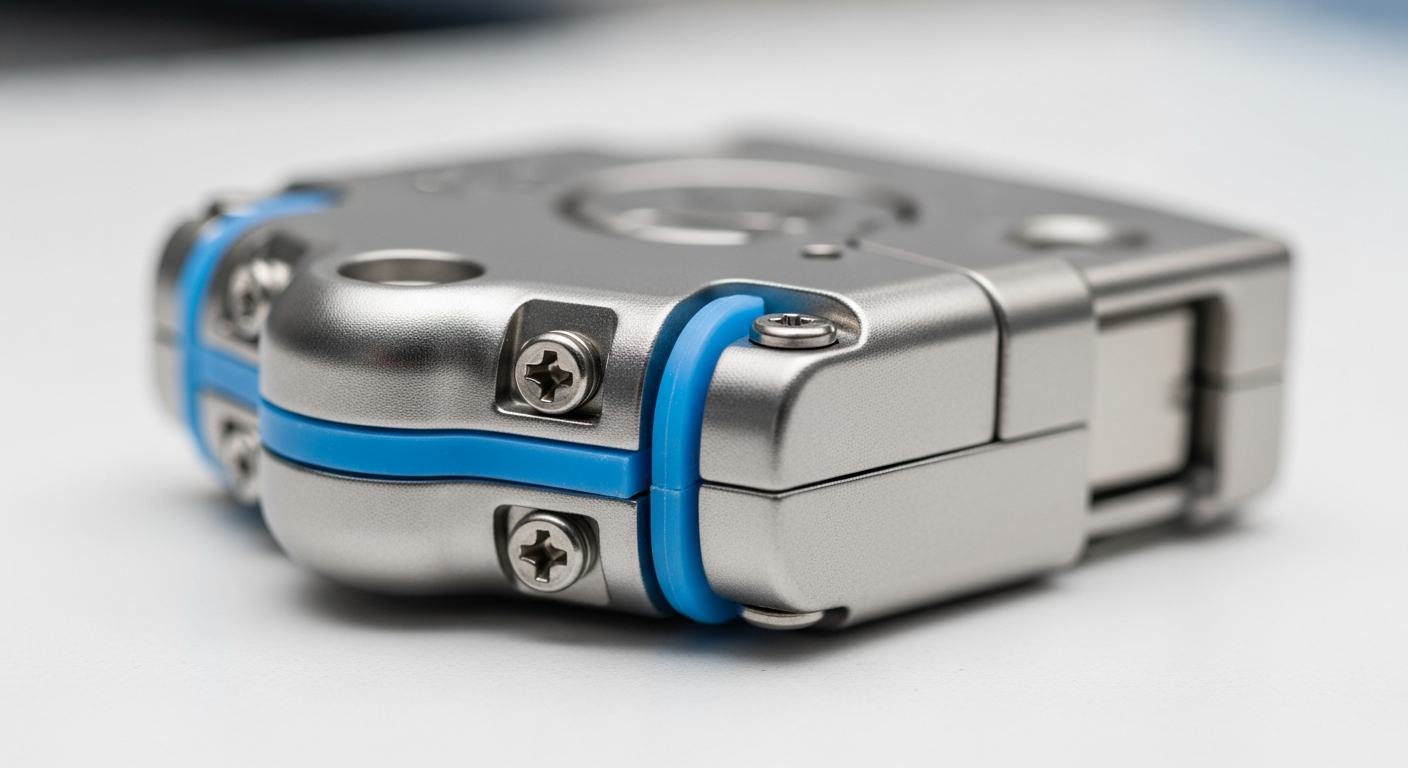
FDA-approved silicone elastomers are used in cardiac pacemakers, cochlear implants, and drug delivery systems. Image: AI-generated illustration.
Silicone rubber has been used in implantable medical devices since the 1950s, when Dow Corning developed the first medical-grade formulations. Today, FDA-approved VMQ silicone is found in:
Cardiac pacemaker housings and lead insulation — must remain hermetically sealed inside the body for the patient's lifetime, exposed continuously to blood and tissue fluids at 37 °C
Cochlear implant bodies and electrode arrays — implanted permanently in the mastoid bone and cochlea
Intraocular lenses — placed inside the eye following cataract surgery; must remain stable in aqueous humour indefinitely
Drug delivery systems and catheter tubing — flexible, chemically inert conduits operating in a saline environment
The FDA classifies silicone as biocompatible for permanent implantation. The human body is, in chemical terms, an aggressive environment: warm, saline, protein-rich, and subject to constant mechanical movement from the heartbeat (approximately 100,000 contractions per day). VMQ silicone does not leach, corrode, swell, or degrade in this environment.
If VMQ silicone is trusted to seal a cardiac pacemaker inside the human body indefinitely — where failure means death — the material's suitability for a roof penetration in a UK climate is not a question worth asking. It is the wrong scale of concern entirely.
5. Nuclear: Containment Vessel Gaskets
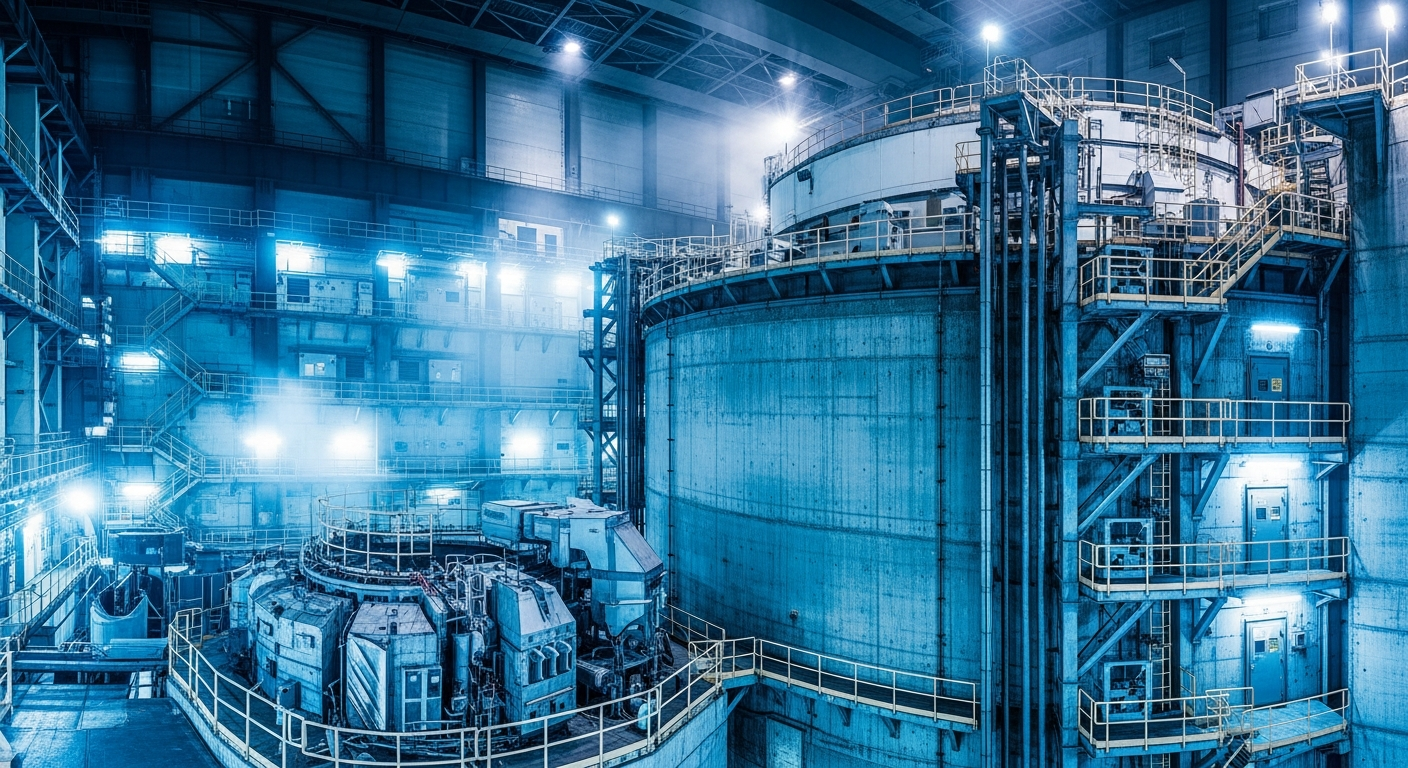
Nuclear containment vessels use silicone gaskets that must maintain seal integrity for the 40–60 year operational life of the plant. Image: AI-generated illustration.
In a nuclear power plant, the containment vessel is the last engineered barrier preventing radioactive material from reaching the environment in a loss-of-coolant accident. Gaskets sealing the containment vessel penetrations must maintain their seating load — and therefore their sealing capability — across the entire operational life of the plant: typically 40 to 60 years, with many plants now being licensed to 80 years.
A published study on ResearchGate, The Prediction of Long-Term and Emergency Sealability of Silicone and EPDM Gaskets, models the long-term sealability of silicone gaskets under the conditions found in nuclear containment: elevated temperature, irradiation, and sustained compression load over decades. Silicone and EPDM are the two elastomer classes consistently selected for this duty.
Published Source
The Prediction of Long-Term and Emergency Sealability of Silicone and EPDM Gaskets — available via ResearchGate. Models the compression set, seating stress relaxation, and predicted leakage rates of silicone gaskets over the operational life of nuclear containment vessels.
No other elastomer is trusted with as serious a consequence of failure as a nuclear containment seal. The fact that VMQ silicone is qualified for this application — alongside EPDM, and above every other elastomer class — is a statement about its long-term stability that no roofing product specification has ever needed to make.
6. What a UK Roof Actually Asks of a Seal
A UK roof subjects a seal to the following conditions over its lifetime:
Environment
Temperature Range
Additional Stressors
UK Roof (worst case)
−10 °C to +70 °C
UV, rain, wind — all at ground-level intensity; peak rain pressure <1.3 kPa (1-in-50-year storm)
Blood/saline environment, 100,000 mechanical cycles per day
Nuclear Containment Gasket
Up to +150 °C sustained
Radiation, high pressure, 40–80 year continuous duty
A UK roof is the mildest environment on this list — by a considerable margin.
The VMQ seal on a SolVe Mount will never see vacuum. It will never be bombarded with atomic oxygen. It will never be asked to resist 62 kPa of pressure differential 20,000 times. Peak rain pressure on a UK roof reaches less than 1.3 kPa in a 1-in-50-year storm — against a seal rated for aerospace pressure boundaries. It sits in a mild, temperate climate, seated within a core hole made through the roof covering itself. When the bolt is tightened, the VMQ seal is compressed axially and expands radially to fill the hole — sealing within the roof covering like a rivet, not on top of it.
7. VMQ vs ABS Solar Flashing: The Honest Comparison
Most solar mounting flashing kits sold in the UK use carbon-stabilised ABS — Acrylonitrile Butadiene Styrene with a carbon black loading (typically 1–2%) to delay UV photodegradation. Carbon black absorbs UV before it reaches the polymer chains, which meaningfully extends outdoor service life compared with unmodified ABS. It is not a permanent solution.
ABS is a thermoplastic, not an elastomer. It does not form a compression seal against the tile. In practice, ABS solar flashing is shaped to overlap the tile surface around the roof fixing and is held down by a hook clipped or tied to the slate. There is no sealant bead at the tile interface. Sometimes neoprene is stuffed between the flashing and the tile to fill the gap, but this is loose packing rather than a formed, load-bearing seal. The flashing carries a typical product warranty of 10 years.
There are three material-level limitations of carbon-stabilised ABS on a UK roof:
Upper service temperature: outdoor-grade ABS is typically rated to +60–80 °C continuous. On a dark-coloured tile in direct UK summer sun, tile surface temperature regularly reaches +70 °C — ABS solar flashing operates at or near its upper service limit on hot days.
Frost brittleness: ABS impact strength drops significantly below 0 °C. UK winters routinely go below 0 °C. A rigid thermoplastic flashing that becomes brittle in frost — held by a hook under mechanical tension — is a stress-cracking risk.
UV photodegradation: the flashing sits fully exposed to UV with no covering above it. Carbon black delays but does not prevent oxidative chain scission of the butadiene component over time. The butadiene phase in ABS is a C–C backbone — inherently less UV-stable than Si–O. Any neoprene stuffing is also subject to UV and ozone degradation.
VMQ Silicone Seal vs Carbon-Stabilised ABS Solar Flashing
Factor
Carbon-Stabilised ABS Solar Flashing
VMQ Silicone Seal
Material type
Thermoplastic (rigid) — Acrylonitrile Butadiene Styrene, carbon black stabilised
Elastomer — Vinyl Methyl Silicone Rubber (ISO 1629)
Warranty
10 years (typical product warranty)
20 years (SolVe Mount)
Outdoor service life
10-year warranted life; UV-exposed with no covering above it
100+ years projected — Arrhenius accelerated ageing studies; Si–O backbone is UV-inert
Sealing method
Mechanical overlap held by a hook tied to the slate; sometimes loose neoprene stuffed at the gap; no formed seal within the roof penetration itself
Core hole made through the roof covering; VMQ seal expands radially when compressed to fill the hole like a rivet — seals within the roof covering, no downward pressure on it
Potential failure routes over time
UV exposure gradually embrittles ABS; the small retaining hook that holds the flashing to the slate is subject to corrosion; neoprene stuffing (if used) slowly degrades under UV and ozone
None identified — expands within the core hole; no hook, no packing, no secondary component to fail
Upper service temperature
+60–80 °C (outdoor ABS) — UK dark tile surfaces reach +70 °C in summer
+200 °C continuous — no meaningful upper limit in any UK roof scenario
Low temperature performance
Brittle below 0 °C — stress-cracking risk at fixing points in UK winter frost
Elastic to −60 °C — retains flexibility through all UK winter conditions
UV resistance
Carbon black absorbs UV but butadiene C–C backbone still degrades over time
Si–O backbone is photochemically inert — does not degrade under UV
Maintenance required
Inspect the retaining hook/clip that holds the flashing to the slate for corrosion; check ABS for cracking or warping; re-examine if neoprene stuffing has compressed permanently
None — fit and forget
Thermal expansion (CTE)
~70–90 μm/m·K — high; creates stress at fixing points under seasonal cycling
~150–300 μm/m·K but elastic — accommodates expansion without loading fixings
Sources: ABS outdoor service life — BS EN ISO 2580; manufacturer product data; ABS temperature range — industry material data sheets; VMQ longevity projection — ScienceDirect: "Lifetime prediction and aging characteristics of silicone rubber" (2024); accelerated Arrhenius thermal ageing methodology.
A note on the 100+ year VMQ projection. Silicone rubber entered commercial production in the 1940s — there is no 100-year real-world outdoor dataset because the material is not yet 100 years old. The projection comes from two independent sources:
Accelerated thermal ageing studies using the Arrhenius method — modelling decades of service life from accelerated laboratory conditions. A 2024 paper in ScienceDirect models the lifetime prediction and ageing characteristics of silicone rubber under synergistic heat-moisture interaction.
Polymer chemistry: the Si–O bond energy (~105 kcal/mol) is greater than the C–C bond energy (~83 kcal/mol) in organic polymers such as the butadiene component of ABS. Greater bond energy means greater resistance to thermal scission and UV photodegradation.
NASA's documented use of silicone seals in docking applications since the Apollo programme gives over 60 years of aerospace performance data in an environment orders of magnitude more demanding than a British roof. No ABS product has an equivalent reference dataset at any comparable stress level.
8. The Verdict
On every engineering measure, the SolVe Mount VMQ silicone seal comes out ahead. It is UV-inert where ABS degrades. It is elastic at −60 °C where ABS becomes brittle. It operates comfortably at +200 °C where ABS approaches its upper service limit on a hot UK roof. It is a single component where ABS flashing is a system of parts. It carries a 20-year warranty where ABS typically carries 10. And its projected material life — based on accelerated ageing studies and the inherent stability of the Si–O backbone — extends well beyond that warranty period.
That said, ABS solar flashing has been used across UK solar installations for 10 to 15 years. Correctly installed and periodically inspected, it does what it is designed to do. This is not a criticism of the product or the installers who have used it — it is a recognised approach that has worked.
The difference becomes most apparent over time. The SolVe Mount's VMQ seal is a single component seated within the roof covering — nothing to hook, stuff, or correct. ABS flashing, by contrast, relies on three parts working together: the ABS body, the small retaining hook that holds it to the slate, and any neoprene stuffing at the gap. Any one can fail before the others — a slate shifting slightly can displace the retaining hook; the hook itself corrodes outdoors over time; and the ABS body, exposed directly to UV with nothing above it, gradually embrittles. It does not crack overnight, but carbon-stabilised ABS subjected to years of UV, frost cycling, and thermal expansion is a materially different product at year 10 than it was on installation day.
The industries that cannot afford any seal failure — space, aviation, medicine, nuclear — have independently converged on silicone elastomers. VMQ seals have been used in those critical applications for decades. A UK roof is the mildest environment on that list by a considerable margin. That convergence is not marketing. It is engineering.